Why Squeaky Clean Skin Isn't Healthy
Grooming, Soap Craftsmanship, Skin Care
Your Skin Isn’t Supposed to Feel Squeaky Clean: What Your Soap May Be Doing Wrong
Step out of a hot shower after a long day and you probably know the feeling: skin almost humming from the heat, shoulders loose, the faint trace of steam still in the air. You towel off and notice something else too—your skin feels tight, almost shrink-wrapped. Your chest and arms squeak a little when you run a hand across them. It feels “extremely clean,” almost polished. For a lot of men, that sensation has been sold as proof that the soap did its job. The harsher the scrub, the better the clean… or so the story goes.
That tight, squeaky feeling is familiar, but it’s not a gold star for your soap. It’s your skin telling you something different: you went a little too far. Clean skin should feel refreshed, comfortable and steady—not parched, itchy, or as if it’s a size too small. When your skin squeaks, it often means your cleanser didn’t just remove the dirt from the day; it also stripped away more of the natural oils that help keep your skin balanced in the first place. The result isn’t “extra clean.” It’s just unprotected.
Clean Doesn’t Have to Mean Stripped
Soap has a straightforward job: lift away what doesn’t belong on your skin. Through a simple bit of chemistry, cleansing ingredients wrap around oils, sweat, and grime so they rinse away with water. A good bar will tackle the sweat from the shop, the dust from the job site, the smoke from last night’s fire, and the buildup of the day’s effort. That’s the honest work of a cleanser, and it matters—especially if you take pride in showing up sharp and put together, no matter how hard you work with your hands or how far you push yourself in the gym or on the trail.
But cleansing has a limit. Your skin isn’t just a surface to scrub; it’s a living barrier. Along with sweat and dirt, your skin also carries a thin layer of natural oils—part of what’s often called the skin’s barrier or acid mantle. These oils help hold in moisture, keep the surface flexible, and support the skin’s ability to protect you from the world outside. When a soap is too aggressive, it doesn’t stop at removing the day’s grime. It strips away too much of that protective layer as well, leaving your skin feeling exposed, tight, and over-scrubbed. That “squeaky” sensation is usually your skin missing the slip and comfort those oils provide, not a sign of superior cleanliness.
The Quiet Work of Your Skin’s Natural Oils
Your skin’s natural oils don’t get much credit. They don’t look impressive on a label and they don’t come in a bottle, but they do important work. These oils help keep the surface of your skin flexible instead of brittle. They slow down how quickly water escapes from the deeper layers. They make it less likely that your skin will crack, flake, or feel rough and overworked. In short, they’re part of why your skin feels like skin, not dry paper stretched over bone and muscle.
When you wash, you’re always going to remove some of these oils. That’s normal. The goal isn’t to leave every bit of oil behind; it’s to avoid clearing the shelves completely. When a bar is too harsh—or when it’s used too often for the job at hand—you end up rinsing away more oil than your skin can comfortably replace between showers. That’s when you start to notice that your forearms look dull, your hands feel rougher than they should, and that tight, pulled feeling lingers long after the towel is back on the hook.
Why Some Men Notice Dryness More Than Others
Not every man’s day is the same, and neither is his skin. If you shower more than once a day, work outdoors, train hard, or wash your hands repeatedly, you’re putting your skin through more frequent cleansing cycles than someone who spends most of his time behind a desk and sticks to one quick rinse. Add in cold, dry weather or heated indoor air in winter, and the deck is stacked even further against your skin’s natural oils. The environment around you is constantly trying to pull moisture out; your soap shouldn’t be working on the same team as the wind and the radiator.
Men who work in the trades, on farms, in warehouses, or on construction sites often need a bar that can cut through serious grime. At the same time, they’re also the ones most likely to feel the sting of over-cleansing: cracked knuckles in winter, tight skin across the back of the hands, a chest that looks weathered before its time. The same goes for men who live in cold or high-altitude climates, or who spend long hours in air conditioning. The more you wash and the harsher your surroundings, the more you’ll notice when a soap is stripping instead of simply cleaning. None of this means you should step back from being clean; it just means your bar needs to be smarter about how it does the job.
Manufacturing Soap vs. Formulating a Bar with Intention
There’s a difference between producing a cleansing product and crafting a bar of soap with a clear purpose. Mass manufacturing often starts with a single priority: efficiency. The goal is to create something that lathers quickly, survives shipping, and meets a basic idea of “clean” for as many people as possible, at the lowest cost. That doesn’t automatically make it bad, but it does mean the bar is often designed around broad averages instead of the way real men actually live, work, and wear their skin day after day. The result can be a bar that does one thing very aggressively—strip oil—and relies on added fragrance and marketing language to make the experience feel richer than it really is.
Thoughtful, handcrafted soap starts somewhere else entirely. It begins with questions: Who is this bar for? How often will he use it? Is this meant for a face that gets shaved several times a week, or for a body that comes home covered in sawdust and sweat? What should his skin feel like ten minutes after he steps out of the shower? At Forge & Crown Soap Works, those questions shape the bar long before a mold is ever poured. The process isn’t about chasing trends or packing a label with exotic ingredients for the sake of appearance. It’s about building a bar from the ground up so that every choice serves a purpose you can actually feel in the water and on your skin.
The Craft of Choosing Oils, Butters, and Superfat
A bar of soap may look simple, but its character is shaped by the oils and butters that go into it. Different oils bring different strengths. Some create big, quick lather that feels almost bubbly and bright. Others give a denser, creamier foam that glides over the skin. Certain oils are known for leaving the skin feeling more conditioned and flexible; others are powerful cleansers that can be too strong on their own if they aren’t balanced correctly. Butters—like shea or cocoa—tend to add richness and a more substantial feel, lending weight and comfort to the bar’s after-feel. None of these ingredients are magic on their own. It’s the way they’re combined, in the right proportions, that determines whether a bar feels punishing or polished, stripped or steady.
One of the quiet tools in a soapmaker’s kit is something called superfatting. In simple terms, superfatting means deliberately leaving a small percentage of the oils in the bar unsaponified—that is, not fully turned into soap. Instead of every drop of oil becoming a cleansing agent, a portion remains as a built-in buffer. Those remaining oils don’t turn a bar into a moisturizer, and they don’t replace a proper lotion, but they can help the finished bar feel less stripping and more forgiving, especially for men who wash frequently. The level of superfat is another dial a craftsman can turn: too little, and the bar may feel austere and dry; too much, and it can feel heavy or leave a film. The right balance depends on what the bar is meant to do and how often it will be used.
Time, Curing, and the Patience Behind a Good Bar
Beyond ingredients, there’s another factor that separates a rushed bar from a considered one: time. After a batch of traditional cold-process soap is poured, it doesn’t go straight into a box. It needs to cure. During curing, excess water evaporates, the bar hardens, and the soap continues to mellow and stabilize. A well-cured bar tends to last longer in the shower, lather more consistently, and feel more refined on the skin. Cutting corners here might make production faster, but it often leads to a bar that dissolves quickly, feels soft or gummy, or behaves unpredictably in the shower. Good curing is invisible when it’s done right, but you feel it in the way the bar holds up and the way your skin feels afterward.
At Forge & Crown, we treat curing as part of the craft, not an inconvenience. Small batches allow us to give each run the time it needs rather than forcing a one-size-fits-all schedule. It’s the same mindset you’d expect from a well-made tool or a properly seasoned piece of cast iron—some things simply perform better when they aren’t rushed. You may never see the curing racks, but you can feel the result in the steadiness of the bar in your hand and the absence of that overly tight, squeaky aftermath on your skin.
Oatmeal, Clays, and Other Honest Additions
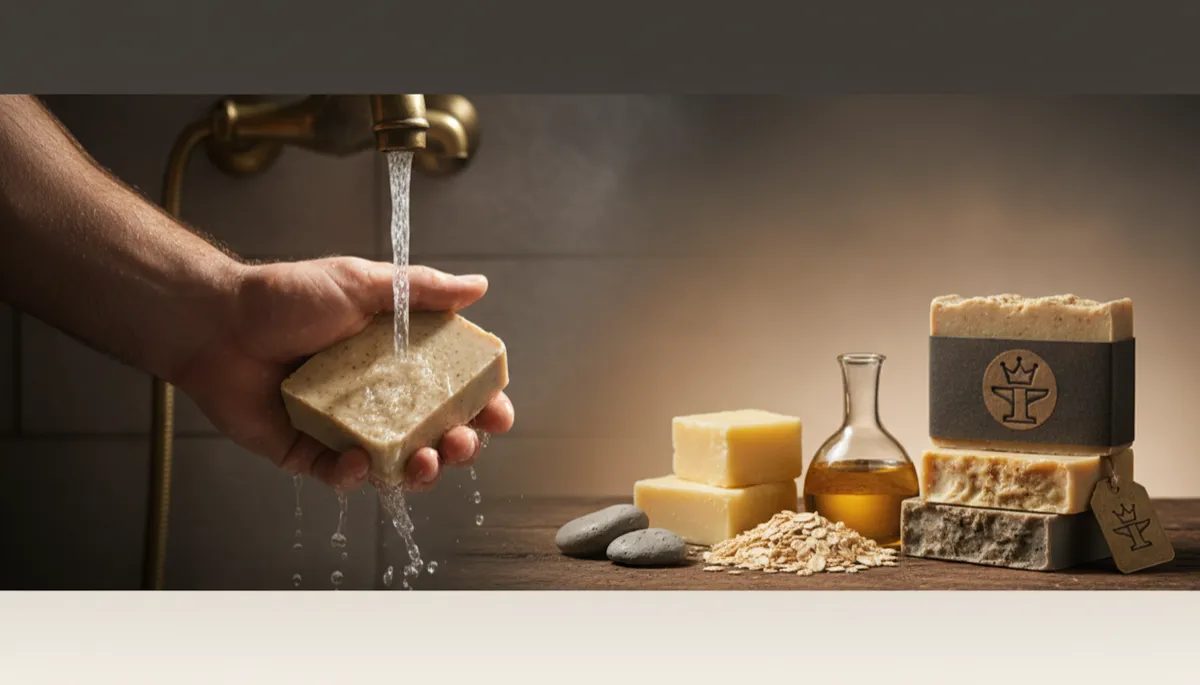
Once the backbone of a bar is in place—the oils, the butters, the cure—there’s still room to refine its character with thoughtful additions. Ingredients like finely ground oatmeal can lend a gentle, natural texture that lightly buffs the skin without feeling like sandpaper. Certain clays can help give the lather a silkier slip and can assist in absorbing excess oil from the surface of the skin, which can be useful in a bar meant for oilier complexions or for men who work up a heavy sweat. Other additions may be there to support scent, to influence the color of the bar, or to subtly shift the way the lather feels between your fingers and across your shoulders.
None of these ingredients are there to perform miracles, and they’re not meant to replace medical care or to treat skin conditions. A bar of soap is still a cleanser first. What matters is that each addition has a reason to be there beyond sounding impressive. In the Forge & Crown workshop, we’d rather include one well-chosen clay that actually changes the way a bar behaves than stack a label with a dozen buzzwords that don’t make a meaningful difference. It’s the same principle you’d apply to a well-built kit in the field: carry what earns its place, leave the rest behind.
Not Every Bar Should Do the Same Job
One of the biggest misconceptions about soap is that a single bar should be able to do everything—face, body, hands, post-workout, after the job site, in every season, for every man. The truth is, your skin doesn’t have the same needs in every situation. A rugged body bar designed to cut through a day’s worth of grease, dust, and sweat has a different mission than a bar meant to be used on your face each morning before you knot your tie or lace up your boots. Treating those jobs as identical is how you end up with a bar that’s too harsh for your face or too mild to handle a truly dirty workday.
A hardworking body bar can lean into stronger cleansing oils and a touch more texture—perhaps a bit of finely milled exfoliant to help lift stubborn grime from your forearms and knuckles. It might be the bar you reach for after stacking firewood, wrenching on the truck, or putting in a long shift on the job site. By contrast, a facial bar usually benefits from a more measured approach: milder cleansing, a carefully chosen superfat level, and a lather that feels smooth and controlled rather than aggressively stripping. An everyday shower bar for most men lands somewhere between those two—clean enough to handle a normal day’s sweat and city grit, yet balanced enough to leave your skin feeling comfortable when you step out of the steam and into your clothes. None of these bars is “better” in a universal sense; they’re simply better suited to the work they’re asked to do.
Honest Formulation Over Empty Claims
It’s easy to talk about soap in absolutes—this kind is always good, that kind is always bad, “natural” is always safer, synthetic is always suspect. Reality is more grounded than that. What matters is how a bar is formulated, how it performs on your skin, and whether it fits the way you live. Some naturally derived ingredients work beautifully; others can be irritating for some people. Some lab-made ingredients are harsh; others are well-studied and reliable. At Forge & Crown, we don’t believe in fear-based marketing or in promising that a bar of soap will solve medical issues it has no business claiming to treat. We respect the line between grooming and medicine, and we stay on the honest side of it.
The goal is not to convince you that handmade soap is automatically superior for every man, every time. It isn’t. A well-formulated bar—whether made in a small workshop or a larger facility—should be judged by the way it cleans, how your skin feels afterward, and how well it fits into your daily ritual. What small-batch craftsmanship allows us to do at Forge & Crown is pay attention: to adjust a recipe when a particular oil ratio feels too austere, to refine a scent when it leans too sharp, to design a bar specifically for the man who showers twice a day in a dry climate versus the man who needs a heavy-duty scrub after a muddy hunt. That attention doesn’t make our bars magic. It makes them deliberate.
The Forge & Crown Philosophy: Crafted, Not Crowded
When we talk about craftsmanship at Forge & Crown Soap Works, we’re not chasing nostalgia for its own sake. We’re talking about a way of working that values clarity over clutter. Every ingredient has a reason to be there. If a butter is included, it’s because it changes the way the bar feels and performs, not because it photographs well. If a clay is added, it’s because it lends the right kind of slip or helps a particular bar suit a particular job. We’d rather build a bar around a handful of solid, dependable ingredients we understand fully than crowd a label with a long list chosen for how they sound instead of how they work together in your hand and on your skin.
Small-batch production isn’t just a badge; it’s a practical choice. It lets us monitor each run closely, tweak formulations when needed, and ensure that the bar you pick up carries the same character we intended when we first drafted the recipe. It also keeps us honest. When you’re the one measuring the oils, cutting the loaves, and seeing the bars cure over time, you feel every decision you made. There’s no hiding behind a marketing department or a distant factory line. The bar either lives up to the Forge & Crown name or it doesn’t, and if it doesn’t, it doesn’t leave the workshop.
Paying Attention to How Your Skin Feels
None of this requires you to become a chemist or memorize every oil that’s ever gone into a bar of soap. It simply asks you to pay attention. Notice how your skin feels ten or fifteen minutes after you step out of the shower. Is that tight, squeaky sensation something you’ve been trained to see as a badge of honor, or is it actually your skin telling you it’s been pushed too far? Does your face feel comfortable after washing, or do you find yourself reaching for a heavy moisturizer just to calm it down? Do your hands feel rough and overworked even on days when the job itself wasn’t especially punishing?
When you find a bar that leaves your skin feeling clean yet steady—no squeak, no sting, just a quiet sense of being refreshed—you’ll know it. That’s the kind of experience we aim for with every Forge & Crown bar, whether it’s a rugged body workhorse, a refined facial bar, or an everyday shower staple with a scent that suits your own sense of character. You don’t need a dozen different products lined up on the shelf. You just need the right ones, built with intention, for the way you actually live.
The Subtle Signature of Good Craftsmanship
In the end, good craftsmanship rarely shouts. It doesn’t always come wrapped in elaborate promises or dressed up in complicated language. Often, it’s noticeable in the quiet details: a bar that doesn’t dissolve into mush halfway through its life, lather that feels substantial without being harsh, skin that feels comfortable instead of squeaky and stripped when you dry off. Those details come from someone taking the time to understand each ingredient, to balance cleansing power with respect for your skin’s natural oils, and to build different bars for different jobs instead of pretending one blunt tool can do everything well.
Your skin isn’t supposed to feel squeaky clean. It’s supposed to feel like your skin—steady, resilient, and ready for whatever comes next. When a bar of soap helps you get there, it’s not because it’s complicated. It’s because someone, somewhere, paid attention. That’s the standard we hold to at Forge & Crown Soap Works, and it’s the difference you can feel every time you step out of the shower and your skin feels quietly right, instead of loudly over-scrubbed.
If you would like to experience good craftmanship get yourself a Forge And Crown Soap Bar