
Rugged but Refined: Modern Masculinity Redefined
Masculinity, Grooming, Lifestyle
Rugged but Refined: Finding Balance in Modern Masculinity
Somewhere between the workbench and the dinner table, between the trailhead and the tailored shirt, a quieter kind of masculinity is taking shape. It is not loud, not defensive, and not interested in proving anything to anyone. It is simply a man who knows he can swing a hammer, split a log, or put in a long day of work—and still care about the way he carries himself, the way his home feels, and the standards he holds for his life. Rugged and refined, without apology, and without needing to choose between the two.
For a long time, the story around masculinity has been framed as a choice: be the rugged man who works with his hands, or be the polished man who cares about details. Live in boots or wear the dress shoes. Sleep under the stars or sit at the well-set table. Many men feel that leaning into one side means turning their back on the other, as if capability and care cannot coexist in the same person. That story is tired, and it has never really been true. Modern masculinity does not require choosing between being rugged and being refined. In fact, the strongest identity often comes from holding both, with intention.
Ruggedness: Capability, Resilience, and Honest Work
Ruggedness is more than a look. It is not just a beard, a flannel shirt, or a pair of boots caked in mud. At its core, ruggedness is about capability—the sense that you can step into a situation and handle what needs to be done. It is knowing how to fix what is broken, carry what is heavy, and keep moving when the work is not glamorous or easy. It is a willingness to sweat, to get dirty, and to take responsibility for the task in front of you, whether that is a broken fence line, a leaky pipe, or a long shift that needs to be finished well.
Ruggedness also speaks to resilience. Life does not always cooperate. Weather changes, engines fail, plans fall apart. A rugged man does not expect comfort at every turn. He expects challenges, and he meets them with steady hands. That might mean enduring a cold rain on a job site, working late to cover for someone else, or quietly carrying a family burden without making a show of it. Ruggedness is the part of masculinity that accepts hardship as part of the deal and keeps going anyway, not because it is heroic, but because it is necessary.
There is also an independence in ruggedness. It is not isolation or stubborn refusal to accept help. It is the calm knowledge that you could handle yourself if you had to. You know how to start a fire, change a tire, read a map, or navigate a tough conversation. You are not helpless in the face of the basic demands of life. That independence often grows out of hard work—hours spent learning tools, trades, or skills that leave marks on your hands and stories in your memory. It might be construction, farming, military service, factory work, or simply years of showing up consistently in whatever field you are in. Ruggedness honors the effort it takes to build and maintain a life.
Refinement: Discipline, Standards, and Self-Respect
If ruggedness is about capability and grit, refinement is about discipline and standards. It is the decision not just to get something done, but to do it well. Refinement is visible in the straightness of a cut, the clean line of a joint, the way tools are put back in their place instead of left scattered. It is the extra few minutes taken to wipe down a surface, to check a measurement twice, or to reread an email before sending it. It is not fussy; it is deliberate. Refinement respects the work enough to honor the details.
Refinement also reflects self-respect. It is how you carry yourself in public, how you speak to people who cannot offer you anything, and how you show up for the people closest to you. It is the decision to present yourself as someone who pays attention—to his clothing, his grooming, his posture, and his surroundings. Not because appearances are everything, but because they say something about how seriously you take your own life. A clean shirt, trimmed nails, a beard that looks intentional instead of forgotten—these are small signals that you respect yourself and the people you are with enough to put in the effort.
At its best, refinement is grounded in good judgment. It is knowing when to speak and when to listen, when to push and when to hold back. It is the ability to read a room, to treat a server with the same courtesy as a client, to make decisions that consider both the short-term and the long-term. Refinement is not about being fragile or polished to the point of uselessness. It is about attention to detail—the details of your work, your relationships, your environment, and your own habits. It is what turns raw capability into something reliable, consistent, and trustworthy.
Neither Side Is Superior: Strength Lives in the Balance
It is tempting to rank these qualities—to say that ruggedness is more “real,” or that refinement is more “evolved.” But in practice, a man built entirely on one without the other is incomplete. Ruggedness without refinement can become careless, harsh, or closed off. Refinement without ruggedness can drift into fragility, overthinking, or dependence on other people’s competence. The strongest identity is a balance of both: the man who can take a hit and still make a thoughtful decision, who can work hard all day and still show up clean, present, and grounded in the evening.
Modern masculinity is broad enough to hold a man who changes his own oil and knows how to choose a good blazer, who can talk torque and timber but can also host guests without scrambling at the last minute. It is not about dominance or superiority over anyone. It is about being complete—capable in the physical world, steady in the emotional one, and intentional about the life you are building. There is no need to apologize for either side. The man who respects both the work and the finish is not confused; he is integrated.
How Balance Shows Up in Everyday Life
You can see this balance in small, ordinary scenes. A pair of worn work boots by the door next to a pair of well-kept dress shoes. The boots tell stories of long days, scuffed floors, and miles walked in all kinds of weather. The dress shoes speak to meetings, dinners, and moments where presence matters as much as performance. Neither pair cancels the other out. Together, they sketch a man who moves between worlds and takes both seriously.
The same is true of a workshop and a well-kept home. A bench stained with oil, sawdust in the corners, metal shavings in a tray—that is a space where things are built, repaired, and tested. It is honest, practical, and sometimes a little chaotic. But step out of that space and into a living room with a swept floor, a solid table, clean counters, and a few things placed with intention, and you see the other side. The man who cares about his home is not less rugged; he is simply extending his standards beyond the project and into the place where he lives, rests, and welcomes others.
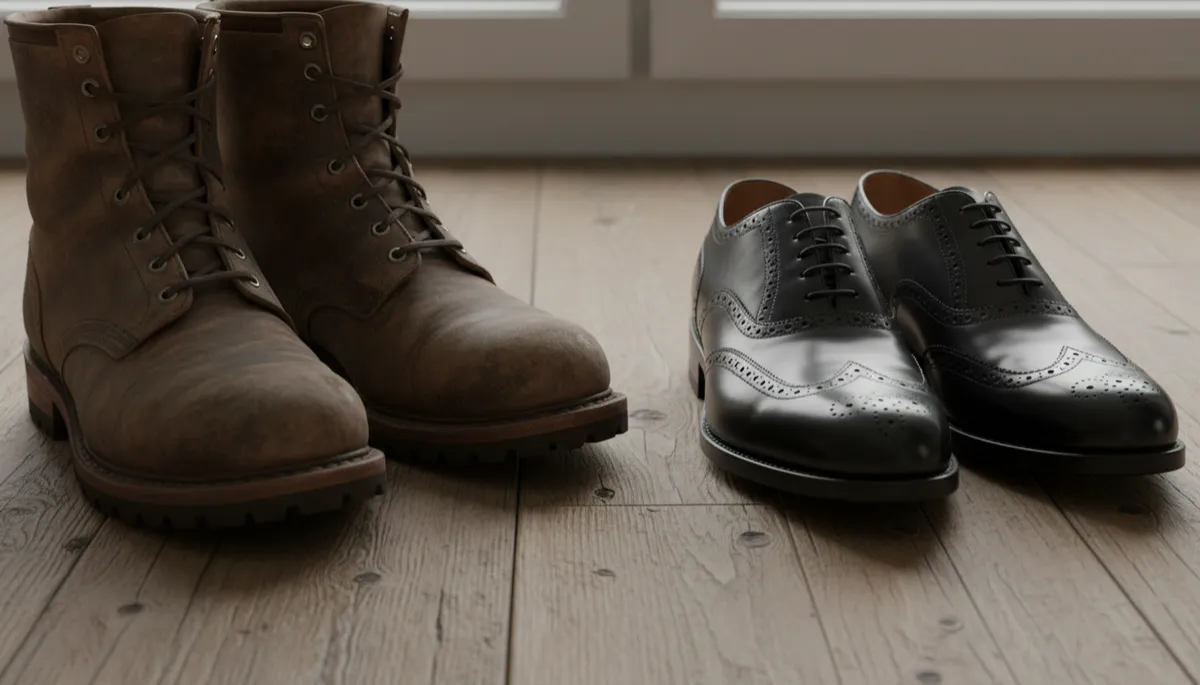
Two pairs of shoes, one balanced life: work, responsibility, and presence.
Consider a weekend: a campfire and a good dinner. You might spend the day outside—stacking wood, hiking a trail, working on a fence line, or coaching on a field. Your hands pick up dirt, your clothes carry the smell of smoke and pine, your body feels the fatigue that only comes from real effort. That is the rugged side. But when the work is done, you wash up, change into a clean shirt, and sit down to a meal that has been thought through—a simple roast, grilled vegetables, a glass of something you enjoy. You talk, you listen, you create a moment that feels intentional instead of thrown together. That is refinement. Both parts matter. One earns the hunger; the other honors it.
Even in the most basic rhythm of the day, you can see the pattern: outdoor work and proper cleanup. You dig, lift, carry, sweat. Then you step inside, rinse away the grit, and return to yourself—clean skin, fresh shirt, the day’s labor still in your muscles but no longer on your face. This is not vanity; it is respect. Respect for your own body, for the people you live with, and for the spaces you share. The balance is not complicated. It is simply refusing to leave the job half-finished, whether that job is the field, the shop, or your own basic care.
Craftsmanship, Clothing, and the Quiet Power of Standards
A man who values both ruggedness and refinement often finds himself drawn to craftsmanship. He notices the weight of a well-made knife, the grain of good wood, the way a solid door closes with a satisfying finality. He reaches for clothing that feels durable in the hand yet sits cleanly on the body—denim that breaks in instead of breaking down, shirts that hold their shape, jackets that look as good after a year as they did on day one. He may not use the word “aesthetic,” but he knows when something feels right, when it is built to last and built with care.
Quality clothing, a reliable watch, a belt that does not fray after a season—these are not trophies. They are tools that quietly support the way he moves through the world. This same mindset shows up in the products he chooses for his home and his routine. He does not need a shelf crowded with options; he prefers a few well-chosen pieces that do their job without fuss. A sturdy mug. A knife that sharpens well. A bar of soap that feels good in the hand, does its work, and leaves him ready for whatever comes next.
Grooming as an Extension of Ruggedness, Not a Rejection of It
Grooming has often been framed as the opposite of ruggedness, as if caring about your skin, your beard, or your scent somehow softens you. In reality, thoughtful grooming is entirely consistent with a rugged life. If you spend your days outdoors, around machinery, in a shop, or on a site, your body takes the impact first. Taking care of it is not about vanity; it is about maintenance. You would not neglect your tools and expect them to perform well. The same logic applies to your own skin, hair, and body. Cleaning up after a long day is simply finishing the job.
A well-kept beard does not make you less tough. It makes you look like you chose it, not like it just happened. Trimming the edges, washing out the dust, and keeping the skin beneath it from drying out are basic forms of care, not indulgences. Healthy skin is not about chasing youth or perfection; it is about preventing unnecessary discomfort and showing up without looking like you have been dragged through the day. A man can split wood in the morning and still smell like cedar and smoke in the evening for the right reasons, not because the day clung to him, but because he chose a scent that fits the life he leads.
Appreciating handcrafted soap, a clean shave, or a distinctive but grounded scent is not superficial. It is consistent with a craftsman’s mindset: choosing tools and materials that are made with care, that feel good to use, and that line up with your standards. Soap is not just soap when you think about it this way. It is part of the daily ritual of stepping out of yesterday’s work and into today’s responsibilities—clean, reset, and ready to go again. There is nothing unmanly about that. If anything, it is a quiet form of discipline.
Forge & Crown: Where Work Meets Standards
This balance between ruggedness and refinement lives at the heart of Forge & Crown Soap Works. The name itself holds the tension clearly. The Forge is the world of heat, metal, and effort. It is the place where raw materials are shaped by hand and by will. In the forge, there is sweat, smoke, and the steady rhythm of work. It represents craftsmanship, grit, and the willingness to stand close to the fire until something solid and useful emerges. It is the side of masculinity that is not afraid of hard days or heavy loads, the side that understands that strength is built, not handed out.
The Crown, on the other hand, speaks to standards, refinement, and responsibility. A crown is not about ego here; it is about ownership. Owning your habits, your choices, and the way you show up. It is the part of a man that says, “This is the level I hold myself to,” and then quietly lives it out. The Crown is visible in a clean sink after you wash up, a properly made bed, a handshake that is firm without being performative, a home that feels cared for even if it is simple. It is pride without arrogance, dignity without drama. Where the Forge shapes, the Crown defines.
Forge & Crown Soap Works sits where these two ideas meet. The products are made for men who understand work, who are not afraid of calloused hands, but who also see the value in stepping into the shower and coming out reset—skin clean, mind clearer, ready for the next thing. The brand does not ask you to choose between grit and polish. It assumes you want both: a life that feels solid under your boots and steady in your reflection.
A Scent World That Mirrors the Man
Even the scent world of Forge & Crown reflects this balance. These are not bright, sugary fragrances that belong more in a candy shop than in a man’s routine. They lean into notes that feel grounded and familiar: cedar, oak, pine—woods that recall cabins, workbenches, and timber stacked for the season. Leather and tobacco that suggest worn chairs, jackets broken in over years, and quiet evenings where conversation runs deeper than small talk. Bourbon, smoke, black pepper—elements that speak to warmth, edge, and the lingering presence of a fire that is still burning low. Sandalwood and amber add a smoother layer, a refined finish that sits close to the skin instead of shouting across the room.
These scents are not about pretending to be something you are not. They are about matching the life you already live or the one you are building. A man who spends his day around sawdust and steel does not need to smell like a chemical storm. He can step out of the shower carrying a trace of cedar and smoke, something that feels like an extension of the world he knows—just cleaner, more intentional, and more refined. The goal is not to impress strangers; it is to feel like yourself at your best: rugged, but put together.
Soap as a Daily Ritual, Not a Statement Piece
At the end of the day, soap is a simple thing. It is there to clean you. Forge & Crown does not pretend that a bar of soap will change your life or solve your problems. It will not make you more of a man, and it is not a substitute for character, discipline, or hard work. What it can do is support the life you are already living by turning a basic necessity into a small, steady ritual that aligns with your values. A bar that feels solid in the hand, lathers well, rinses clean, and leaves your skin feeling comfortable instead of stripped or coated—that is enough. No wild claims, no promises of transformation, just honest function with a sense of craftsmanship behind it.
Using a well-made soap, paying attention to how it feels and smells, is one more way of saying, “The details matter.” Not in a showy way, but in the same quiet way you might sharpen a blade before a job, check the oil before a long drive, or wipe down your tools before hanging them back on the wall. It is a small act of respect—for yourself, for the people who share your space, and for the work you are going to do tomorrow. You step into the shower carrying the day’s grit and sweat; you step out ready to face the next thing without dragging yesterday along with you.
Many Paths, One Standard
It is important to say that this vision of rugged yet refined masculinity is not limited to one type of man or one line of work. You might be on a construction site, in a mechanic’s bay, in a warehouse, or on a farm. You might also be in an office, a classroom, a studio, or a kitchen. Ruggedness can look like steel-toed boots and safety glasses, but it can also look like long hours at a desk solving hard problems, showing up for your family when you are exhausted, or standing firm in a difficult conversation. Refinement can be a tailored jacket and a pressed shirt, or it can be the way you listen carefully, the way you organize your tools, or the way you keep your home in order even when no one is watching.
Modern masculinity leaves room for all of these expressions. What ties them together is not a specific style, job, or hobby, but a standard: doing what needs to be done, and doing it with care. That standard shows up in your work ethic, your relationships, your habits, and yes, even in something as simple as the bar of soap by your sink. The details add up. They always have.
The Forge & Crown Philosophy: You Don’t Have to Choose
In the end, the message is straightforward: a man does not have to choose between the workshop and the dinner table, the trail and the tailored shirt, or calloused hands and self-care. He can stand in all of those places and still be fully himself. He can spend the day under a truck, behind a saw, in front of a screen, or out in the weather, and still step into the evening clean, composed, and present for the people who matter to him. He can appreciate a good meal, a well-made chair, a sturdy pair of boots, and a bar of soap that does its job without compromise. None of these things cancel each other out. Together, they tell a fuller story.
Forge & Crown exists for that man—the one who respects the Forge of work, effort, and craftsmanship, and who wears the Crown of standards, self-respect, and responsibility without needing to announce it. The products are built to stand quietly in the background of a life lived on purpose, supporting the daily rituals that keep you sharp, steady, and ready. If that philosophy resonates with you, if you see yourself somewhere between the grit and the finish, the smoke and the sandalwood, the boots and the dress shoes, then Forge & Crown Soap Works is worth exploring. Not as a statement, but as another tool in a life that is both rugged and refined—by design.