The Art of Craftsmanship: Superior Small Batch Soap
Craftsmanship, Small Batch Soap, Grooming
The Art of Craftsmanship: Why Small Batch Soap Is Superior
There is a quiet satisfaction in reaching for a bar of soap that feels as if it were made for your hand alone. The weight, the cut, the grain of the surface, the first breath of cedarwood and smoke that rises when it meets hot water—none of it is accidental. It is the result of choices, of restraint, of a maker standing over a stainless-steel table and deciding that this batch, like every batch, will be small enough to control and large enough to matter. At Forge & Crown, that is where the work begins: not with a marketing brief or a production quota, but with a commitment to craftsmanship that treats even an everyday bar of soap as something worth doing properly.
What “Small Batch” Really Means
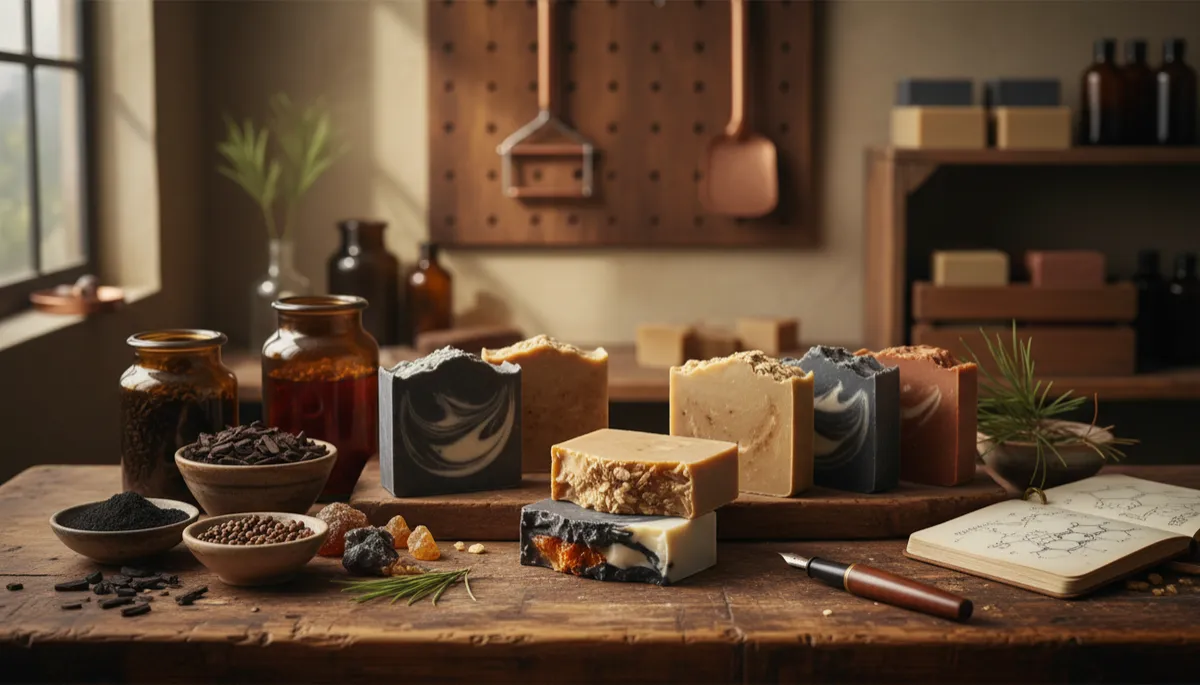
“Small batch” is a phrase that gets tossed around easily. In handcrafted soapmaking, it is more than a romantic label; it is a technical decision. A small batch is one a maker can see, smell, and correct in real time. It is a pot of soap batter that can be stirred by hand or with a single immersion blender, not a vat that requires a forklift and a control panel. It means every mold is close enough to inspect, every swirl of charcoal and clay still visible before it sets, every bar traceable back to a particular day’s work.
In practice, small batch at Forge & Crown means working in controlled, repeatable quantities—dozens of bars at a time, not thousands. Each batch has its own formula sheet, its own notes, its own observations about how the oils behaved, how quickly the soap moved, how the cedarwood and vetiver opened up once the lye solution hit the warmed oils. It is large enough to be efficient, but restrained enough that if something feels off—the color of the batter, the way the fragrance is blooming, the speed of trace—the maker can respond immediately. That scale is where true craftsmanship lives: close enough to touch, small enough to own the result without excuses.
Why Forge & Crown Chooses the Small Batch Path
Forge & Crown could choose to grow by chasing volume. The grooming market rewards scale: automated lines, bulk contracts, endless shelves of identical bars stamped out by the second. Yet the brand holds its ground in the small batch lane for three reasons: attention, control, and respect for the craft. Attention is the willingness to stand at the bench and watch the way a bourbon-and-amber blend threads through raw soap, to listen to the faint change in sound when oatmeal is folded in, to notice the subtle shift in color as charcoal disperses. It is the opposite of setting a machine and walking away.
Control is the practical backbone of that attention. Working small allows Forge & Crown to choose robust base oils, to keep superfat levels where skin feels clean but not stripped, to adjust water content for a harder, longer-lasting bar, and to dial in fragrance loads so that sandalwood and black pepper speak clearly without shouting. If a particular patchouli harvest runs deeper and smokier than last season, the formula can be nudged to meet it. There is no obligation to force natural materials into a rigid industrial template. Small batch gives the maker the ability to respond to ingredients as living, changing things, not just line items on a spreadsheet.
Above all, Forge & Crown values small batch because it honors the work. There is a certain masculine straightforwardness in saying: we will make less, but we will make it better. No shortcuts, no hollow claims, no pretending that craftsmanship can be automated. Each batch is an investment of time and skill, and the brand is comfortable letting that show in the finished bar rather than hiding behind marketing gloss. When you hold a Forge & Crown bar, you are holding the outcome of a deliberate choice to keep production close to the maker’s hands.
The Cold-Process Tradition: Simple Chemistry, Serious Craft
At the heart of Forge & Crown’s approach is cold-process soapmaking—a tradition that is both rugged and surprisingly refined. The science is straightforward, but it deserves to be told plainly. Soap is created when fats or oils meet a strong alkali in the right proportions. In cold-process, that alkali is usually sodium hydroxide dissolved in water, forming what soapmakers call a lye solution. When this solution is slowly blended into a carefully measured mix of oils—olive, coconut, shea, tallow, or others—a chemical reaction called saponification begins. The oils and lye transform into soap and glycerin, molecule by molecule, until no free lye remains when the process is complete.
Unlike melt-and-pour or fully hot-processed methods, cold-process relies on time and controlled temperatures rather than external heat to drive that reaction. The batter is usually poured into molds while still fluid, then insulated to allow its own gentle warmth to carry it through what soapmakers call “gel phase.” This is where the bar develops its internal structure, where the clays settle into their roles, where the charcoal ribbons soften from harsh black into velvety gray swirls. Because the process is slower and more direct, the maker has more room to incorporate distinctive ingredients—bentonite clay for slip, kaolin for a silky feel, oatmeal for texture, activated charcoal for a deep, grounding presence—without cooking them into oblivion.
Cold-process also preserves the naturally occurring glycerin that forms during saponification. In large industrial operations, glycerin is often removed and sold for other uses. In a Forge & Crown bar, it stays where it belongs, contributing to that familiar, comfortable glide on the skin. There are no miracles here, no exaggerated promises—just honest chemistry handled with care. The method has been used for generations because it works, and because it leaves room for the maker’s hand and mind to shape the outcome.
The Discipline of Curing: Letting Time Do Its Work
Once the soap has been poured, swirled, and cut, the hardest part begins: waiting. Freshly cut cold-process bars are still soft, their internal chemistry unfinished. The saponification reaction continues quietly for the first day or two, but the real transformation happens over weeks as water slowly evaporates and the bar hardens. This period is called curing, and it is where patience separates true small-batch craftsmanship from rushed production. A well-cured bar lasts longer in the shower, lathers more generously, and feels more composed in the hand. The edges firm up, the surface tightens, and the scent settles into its mature character—cedarwood deepens, tobacco softens, a ribbon of amber rises where it was once buried under top notes of pine or citrus.
Forge & Crown does not treat curing as a technicality; it is a non-negotiable step. Bars rest on open racks in a controlled environment, spaced so that air can reach every side. The maker walks those racks, turning bars, checking weight loss, noting how a bourbon-and-smoke blend changes from week two to week four. Some recipes demand more time—high-olive or heavily superfatted bars might cure longer to reach their full potential. The brand could push them out sooner and claim “ready to use,” but that would be convenience winning over craft. Instead, Forge & Crown lets time work quietly in its favor, accepting that a four- or six-week cure is not an inconvenience but a mark of respect for the process and for the person who will eventually lather up with that bar at the end of a long day.
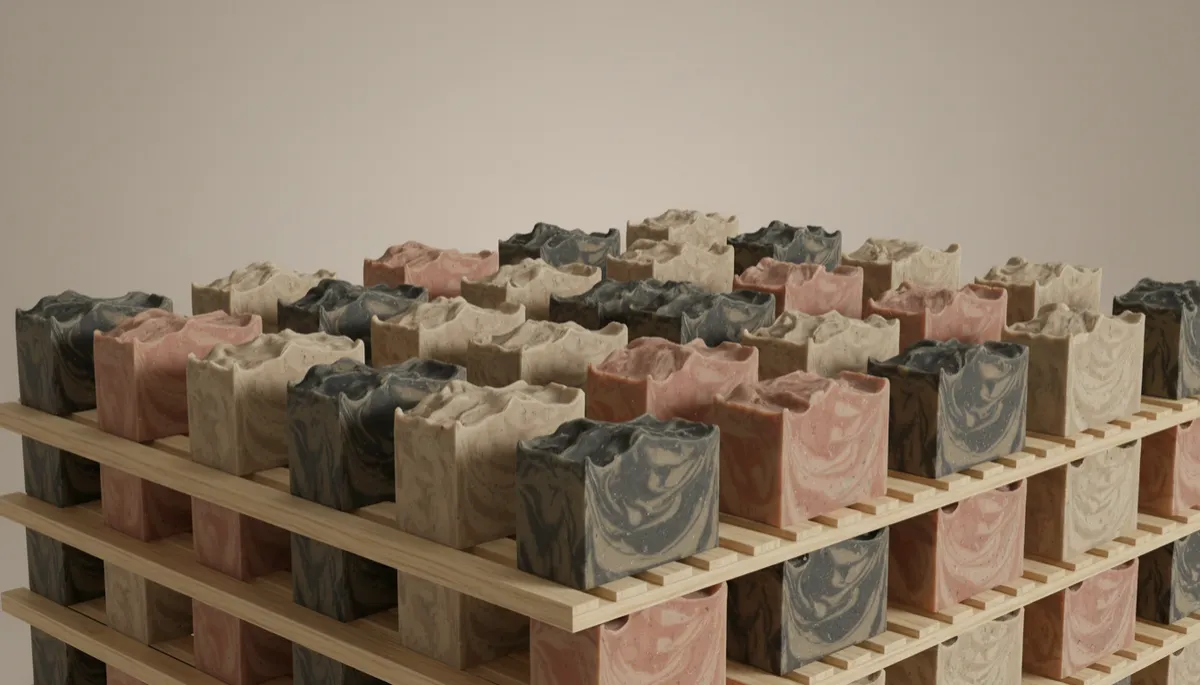
Weeks of curing turn raw soap into dense, long-lasting bars with settled scent.
Inside the Forge & Crown Workshop
Step into the Forge & Crown workshop and the first thing you notice is not the equipment, but the air. It carries layers: dry cedar and fresh-cut pine from one rack, a darker trail of tobacco and leather from another, the faint mineral edge of clay and charcoal lingering underneath it all. Stainless steel tables stand in the center of the room, flanked by sturdy wooden molds lined in crisp paper. Scales sit ready, not as props but as essential instruments; every gram of oil and lye is weighed, not guessed. This is not a factory floor. It is closer to a small distillery or a well-run forge—practical, ordered, and built for hands-on work.
The process begins with measuring. Oils are decanted from drums into pitchers, their viscosity telling a story even before the numbers confirm it. Coconut oil, solid at room temperature, yields under gentle heat, turning clear and sharp. Olive oil pours slow and steady, a muted green-gold ribbon. Tallow or other hard fats are melted just enough to blend, not scorched. Each component is warmed and combined until the base is uniform, then allowed to cool to a precise range so that when the lye solution meets it, the reaction is controlled rather than chaotic. This is where small batch shows its value: a single maker can watch the thermometer, feel the side of the pot, and know when the moment is right.
Fragrances and essential oils are measured next, each blend built with intention. A cedarwood and pine profile might be grounded with vetiver and a trace of patchouli, the forest floor beneath the canopy. A bourbon-and-amber bar might carry a slow burn of black pepper and a curl of smoke, like the moment you open an old wooden cabinet in a quiet bar. Tobacco and leather find their place as accents rather than blunt instruments, woven into the base so that the scent unfolds rather than shouts. These are not random combinations; they are signatures, tested and refined batch after batch until they feel inevitable, as if they could not have been any other way.
When the lye solution is ready—clear, cooled, and handled with the respect it deserves—it is poured slowly into the oils. An immersion blender hums to life, cutting through the mixture in deliberate passes. The batter thickens from thin cream to something closer to custard, reaching what soapmakers call “trace,” when a drizzle across the surface leaves a faint line before sinking back. At this point, there is no room for distraction. Clays are added and folded in, giving the batter weight and slip. Oatmeal goes in, lending a rugged texture that will later feel like a gentle scrub against the skin of a palm or forearm. Charcoal is introduced in ribbons or layers, depending on the design, creating the deep, smoky swirls that have become a Forge & Crown hallmark in certain bars.
Pouring is its own craft. The batter flows into the molds in steady streams, sometimes layered, sometimes dropped and pulled with a thin blade to create a subtle, marbled pattern. There is no loud color here, no gimmicks—just tonal variations of cream, gray, charcoal, and clay, a neutral palette that feels at home on a bathroom shelf built of stone, metal, or dark wood. The surface is smoothed or textured by hand, then the molds are wrapped or lidded to hold in the gentle heat of saponification. Over the next day, the soap sets enough to cut. A wire cutter or sharp blade slides down, separating the loaf into individual bars. The sound is quiet but distinct—a soft, clean slice, followed by the sight of the internal pattern revealed for the first time. This is where the maker sees whether the swirl landed exactly as intended or took on a life of its own.
Natural Variations: Character, Not Flaws
In a high-volume factory, the goal is sameness. Every bar must look identical, down to the millimeter and shade of color. Small-batch soapmaking accepts a different standard: consistency in quality, not in uniformity of appearance. At Forge & Crown, two bars from the same batch will share the same formula, the same cure time, the same performance in the shower. But the charcoal swirl may arc a little higher on one, the oatmeal may cluster more visibly on another, the top may hold a slightly different ripple where the spatula lifted away. These are not defects; they are the grain of the work, like the pattern in a piece of leather or the knots in a plank of oak.
Natural variations speak to the presence of a maker. They say: a human being stood here and poured this, cut this, stacked this on a curing rack. Over time, a trained eye can tell a Forge & Crown bar by these signatures—the way a charcoal-and-clay design is weighted toward one corner, the particular muted tone of a tobacco-and-amber bar, the lean, practical cut that favors use over decoration. For customers who value authenticity, these small differences are part of the appeal. They are reminders that the bar in their hand is not one of millions pressed from a steel die, but part of a limited run shaped by attention and care.
Rugged but Refined: A Working Philosophy
Forge & Crown’s philosophy can be summed up in four words: rugged but refined. It is an approach that respects both the grit of daily life and the quiet pleasure of well-made things. In soapmaking, that means building bars that can stand up to real use—a bar that lives on a sink in a workshop, in a locker-room shower, or beside a shaving mug—while still carrying a level of detail and balance you would expect from a tailored jacket or a well-made pair of boots. The rugged side shows up in the choice of ingredients: oatmeal for texture, charcoal for a deep, grounding presence, clays that lend a firm, clean-handed feel. These are materials that do their job without fuss.
The refined side comes through in the way those ingredients are handled. Cedarwood is chosen not just for its name, but for its particular profile—dry, resinous, and steady, rather than sweet. Vetiver is used with restraint, enough to give a bar that damp-earth backbone without turning it into a caricature of “outdoors.” Patchouli, when it appears, is cleaned up and modern, more leather and soil than incense. A bourbon note is not a sugary imitation of a cocktail, but a warm, woody echo that plays well with smoke and amber. Even the cut of the bar reflects this ethos: edges are clean, proportions are generous without being bulky, the overall impression is of something built to be used, not simply displayed. Rugged but refined is not a slogan; it is a standard applied at every stage, from the formula sheet to the final wrap.
Small Batch vs. High-Volume: A Fair Comparison
It is easy to paint high-volume manufacturing as the villain and small-batch makers as heroes, but the reality is more nuanced. Large-scale production has clear advantages. It brings down cost, making basic hygiene accessible to more people. It delivers predictable performance across millions of bars, and it can meet the demands of large retailers with tight timelines. For a hotel chain or a big-box store, that consistency and price point matter. There is nothing inherently wrong with that model; it serves a purpose, and it does so efficiently.
Where high-volume manufacturing struggles is in the finer points of craftsmanship. When a bar is one of ten million, there is limited room for distinctive ingredients like specialty clays, thoughtfully built scent profiles, or long curing times that tie up warehouse space. Formulas are often optimized for speed of production, low cost of raw materials, and shelf stability under harsh conditions. That can mean stripping out naturally occurring glycerin, relying heavily on synthetic detergents, or flattening scent into something that reads as “fresh” but forgettable. Again, these are trade-offs, not moral failings. But they are trade-offs that Forge & Crown chooses not to make.
Small-batch craftsmanship, by contrast, is less efficient on paper but richer in detail. It allows for long cures, for the use of charcoal and oatmeal in meaningful amounts, for scent blends that would be too complex or costly to run on a massive line. It supports transparency: a customer can ask how a bar is made, what goes into it, and get a direct, specific answer. For Forge & Crown, that trade—volume for depth—is worth making. The brand is not interested in being everywhere; it is interested in being unmistakable wherever it does appear.
Why Customers Choose Small-Batch Soap
People who reach for small-batch soap are not usually chasing miracles. They are looking for something more straightforward: craftsmanship they can feel, transparency they can trust, and a connection to the person who made the bar they are using every day. There is a certain grounded satisfaction in knowing that your cedarwood-and-charcoal bar was poured a few weeks ago by someone who could tell you exactly which oils went into it and why. You are not just buying a product; you are choosing a way of doing things—slower, more deliberate, more accountable.
Distinctive scents are a major part of that draw. A Forge & Crown bar does not smell like generic “sport” or “ocean breeze.” It might open with pine and black pepper, settle into sandalwood and amber, and leave a quiet trail of smoke and leather on the skin. Another may lean into vetiver and tobacco, grounded and steady, like a worn leather chair in a room lined with books. These are not loud fragrances that linger aggressively; they are well-constructed profiles that feel at home in a man’s routine, from the morning shower before work to the wash-up after a day in the field or the shop. Customers come back to them because they recognize themselves in those scents—uncomplicated, confident, and comfortable in their own skin.
Supporting small-batch makers is also a choice about where your money goes. When you buy from a brand like Forge & Crown, you are sustaining a workshop, not a conglomerate. You are funding more time at the bench, more experimentation with clays and oils, more refinement of scent profiles. In return, you get a level of responsiveness that large companies cannot match. If customers say a particular bourbon-and-amber bar feels best with a touch more smoke and a little less sweetness, that feedback can find its way into the next batch, not into a distant suggestion box. It is a conversation, not a broadcast.
Craftsmanship in the Everyday
In a world that moves fast, it is easy to reserve the word “craftsmanship” for big-ticket items: a truck, a watch, a piece of furniture that will be handed down. Soap, by comparison, seems humble. It is used up and washed away. But that is exactly why it deserves attention. This is something that meets your skin every day, that waits on the sink or in the shower when you come in from the cold, from the gym, from the jobsite. It is part of the ritual of resetting, of getting ready to step back out into the world. Treating that object as an afterthought is a choice. So is treating it as something worth doing well.
Forge & Crown takes the second path. Every small batch is an expression of a simple belief: that even routine moments deserve tools built with intention. The cold-process method, the measured ingredients, the weeks of curing, the honest acceptance of natural variation, the rugged-but-refined scent profiles—none of it is for show. It is there so that when you pick up a bar, you can feel, even before the first lather, that somebody paid attention. The cut sits right in your hand. The surface has a quiet texture from oatmeal or clay. The scent rises in layers, not in a rush. Under hot water, the bar holds together instead of melting away. These are not accidents; they are the fingerprints of craft.
Choosing small-batch soap is not about rejecting convenience outright. It is about deciding where convenience ends and where quality begins. There will always be a place for the quick grab from a supermarket shelf. But there is also room, in a man’s cabinet or on his sink, for something quieter and more considered. A bar that carries cedarwood and smoke instead of synthetic “freshness,” that bears the mark of a maker instead of a machine, that stands as a small, daily reminder that doing things well is its own reward. In that sense, a Forge & Crown bar is more than soap. It is a statement about how you move through the world: deliberate, grounded, and unwilling to settle for less when better is within reach.
Craftsmanship still matters, even in the most ordinary objects. Especially in them. The next time you reach for a bar of soap, consider what went into it—whether it was pushed through a system built for speed, or guided through a process built for care. If you are ready to feel the difference that small-batch, cold-process soap can make in your daily routine, the doors of the Forge & Crown workshop are open. Take a look at the brand’s handcrafted soaps and grooming products, and choose the kind of attention you want waiting for you at the sink.